I Am Street Guy
- 4.3
- Rating
- 500.00K
- Installs
- Free
- Price

 Analysis by App-foxy
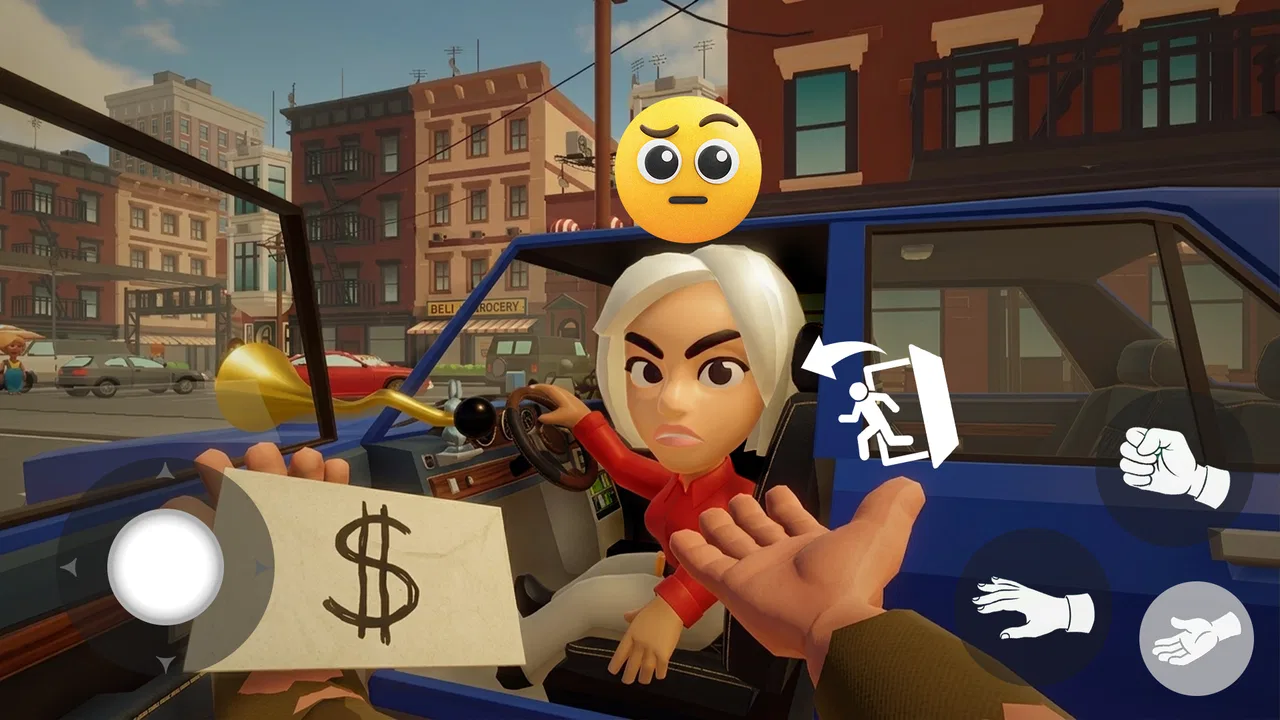
I approached I Am Street Guy expecting a small, casual simulation game, but its central idea is more interesting than that label first suggests. You step into the role of a street survivor, move through a city, look for useful things, and create trouble by pranking pedestrians. That combination gives the game a playful push-and-pull: you are not simply completing tidy missions, and you are not only wandering around without purpose. You are constantly deciding whether to search, experiment, or cause a little chaos.
That focus on scavenging is the part I found most important. It changes the city from a backdrop into something I actively inspect. A bench, corner, passerby, or overlooked object can become part of the next small plan. The game is free, rated for Everyone, and developed by M4P Media, so it is easy to approach as a quick, low-pressure experience. My recommendation is strongest for players who enjoy playful urban sandboxes and short bursts of experimentation rather than deep simulation systems.
Scavenging is the idea that gives the city a purpose
The store summary presents the game as an exploration of city life from the viewpoint of a street survivor, with scavenging and pranks at its center. In practice, that pairing matters. Searching alone could feel like a repetitive collection task, while pranking without preparation could become a sequence of disconnected jokes. Putting both actions together gives each activity a reason to exist.
You May Also Like

 AccuWeather: Weather Radar
AccuWeather Review: A Quick, Clear Forecast for Everyday Decisions
For everyday plans, the best forecast is the one you can understand quickly. AccuWeather makes rain timing, radar, and local conditions easy to act on, with a few trade-offs.

 Hill Climb Racing
Why Hill Climb Racing Still Turns Crashes Into One More Run
A tiny car, a bumpy hill and one more upgrade: Hill Climb Racing keeps resurfacing because its simple chaos makes every near-miss feel personal.

 AliExpress - Shopping App
AliExpress Makes Global Shopping Feel Personal, but Shoppers Bear the Risk
AliExpress turns a global marketplace into a pocket-sized discovery engine. Its reach is useful, its shopping loop compelling, and its trade-offs easy to miss.

 Lords Mobile: Kingdom Wars
Lords Mobile Is a Kingdom-Building Routine, Not a Quick Match
A case-by-case verdict on the building, battles, device demands, and social commitments that make Lords Mobile rewarding for some players and exhausting for others.

 PDF Scanner app - TapScanner
TapScanner Makes Paperwork Easier to Capture, Check, and Share
TapScanner makes scanning with a phone feel less like a rescue operation and more like a dependable step in getting work done. Its capture tools are useful, though not flawless.

 Block Blast!
 Shows How Much a Puzzle Game Can Leave Out
A quiet grid game shows why puzzle players increasingly value instant clarity, repeatable skill and low-pressure play—and where the genre still needs to catch up.
More From Our News Desk
View All News


I found myself looking at the surroundings differently once I treated scavenging as preparation rather than as a goal on its own. Instead of moving directly from one obvious point to another, I wanted to understand what the environment might offer before approaching pedestrians. That small change in mindset is the game’s most effective trick. It encourages curiosity without needing a complicated explanation.
The appeal is not realism in the traditional sense. This is a light simulation built around a mischievous fantasy, not a serious attempt to reproduce the difficulties of real street survival. The street setting supplies recognizable situations, while the playful tone keeps the consequences approachable. That makes the experience suitable for players who want a humorous city playground rather than a demanding survival simulator.
One useful way to play is to divide each visit into three stages. First, I scan the area and learn its layout. Next, I gather anything that seems relevant. Only then do I approach pedestrians and test an idea. This rhythm is more satisfying than immediately trying random interactions, because it makes even a simple prank feel prepared. It also reduces the sense that progress depends entirely on guessing.
The strongest capability here is turning ordinary city exploration into a setup for interaction. The game does not need to overwhelm me with menus or elaborate systems to create that effect. Its value comes from the relationship between what I find and what I decide to do with it. If you enjoy noticing details and trying unusual solutions, that loop is likely to carry the experience for you.
What a normal play session feels like
A typical session works best when I give myself a small objective rather than trying to solve the whole city at once. I might begin by exploring one stretch of the environment, checking what can be collected or used, and then choosing one pedestrian interaction to test. This approach keeps the game readable and makes the result of each experiment easier to understand.
The most enjoyable moments come from the gap between intention and outcome. I may think I have found the perfect setup, only to discover that the situation does not unfold as expected. That is not necessarily a failure. In a game built around pranks, an unexpected result can be more entertaining than a perfectly efficient one. I would rather see the game reward curiosity than force every action into a predictable checklist.
For that reason, I suggest resisting the urge to rush through the streets. Move slowly enough to notice possible opportunities, but not so slowly that exploration becomes a chore. When I treated every object or passerby as a potential clue, the environment felt more active. When I simply crossed the area without looking, the game became much thinner.
Players wondering whether this is a game they can pick up briefly should find the format approachable. The premise is easy to understand, and the basic cycle does not require a long explanation before it becomes playable. It suits a quick break, especially when I want something interactive but do not want to commit to a large story or a complicated management system.
At the same time, the open-ended nature can make the experience feel less guided than a conventional mission-based game. If you need clear objectives, constant rewards, or a strong narrative thread, you may find yourself asking what to do next. I see that uncertainty as part of the design, but it will not appeal to everyone. The game expects the player to create some of the fun through experimentation.
A realistic everyday use case
Imagine having a short wait before an appointment. I would open the game, spend the first few minutes checking a nearby section of the city, and choose a single scavenging-and-prank idea to investigate. If it works, I get a compact sense of completion. If it fails, I still have a funny experiment to remember and can close the game without feeling that I abandoned a major campaign.
That scenario explains where the game fits better than a long evening of uninterrupted play. It is well suited to short sessions in which the goal is to try something, observe the result, and decide whether another experiment sounds appealing. The city setting gives those brief sessions a little context, while the prank premise keeps them from feeling like routine errands.
There is also a useful social angle, even when playing alone. I can imagine showing another person a strange interaction or discussing what might happen if I approached a situation differently. The game’s premise naturally creates “what if” questions. That makes it more suitable for sharing discoveries than a purely linear game where every player sees the same sequence.
My practical advice is to make your own small challenges. Try to explore an area before interacting with anyone. Try to use the first useful thing you find rather than searching indefinitely for a perfect option. Then repeat the same route with a different approach. These self-imposed rules give the scavenging mechanic more structure and help reveal whether its freedom works for you.
Where the playful design starts to show limits
The same freedom that makes the game approachable can also make it feel lightweight. I would not choose it as a replacement for a deep survival simulation with resource pressure, detailed crafting, complex character development, or a long-term economy. The street-survivor theme may suggest those systems, but the experience is better understood as a playful simulation centered on exploration and pranks.
That distinction is important before downloading. If you want intense consequences, realistic hardship, or a carefully plotted urban drama, this is probably the wrong choice. The tone is more mischievous than serious. I enjoyed that because it keeps the game easy to enter, but players looking for emotional weight may find the premise too shallow.
Another tradeoff is that experimentation can become repetitive if you do not enjoy inventing your own objectives. The first discoveries have more impact because everything feels new. Later, the value depends on whether the interactions continue to surprise you or whether you are satisfied repeating familiar routines. I recommend it more confidently to curious players than to completionists who need a visible list of substantial goals.
The controls and interaction logic also matter more in a game like this than they would in a straightforward puzzle. When the fun depends on approaching the city at the right moment and testing an idea, any friction in movement or interaction can interrupt the joke. I would pay attention to how comfortable you are with exploratory games that sometimes require trial and error. This is not an experience I would recommend if you become frustrated whenever the game does not immediately explain the intended solution.
Because it is free, the barrier to trying it is low. Still, “free” does not automatically mean it will suit every player’s time. The real cost is attention: you need to be willing to look around, form a plan, and accept that some experiments may not produce a satisfying result. For me, that tradeoff is fair when I play casually, but it is less attractive when I want guaranteed progress.
How it compares with familiar alternatives
Compared with a conventional city-building simulation, this game is much more personal and immediate. You are not managing budgets, zoning districts, or a growing population from above. The focus stays close to the street, where your decisions are small, direct, and mischievous. Choose this game when you want to inhabit a situation rather than administer an entire city.
Compared with a traditional survival game, it also feels gentler. The street-survivor perspective provides the theme, but the main attraction is the playful search-and-prank loop rather than a harsh struggle for long-term survival. If you prefer gathering materials to support a large crafting tree, another survival title will likely give you more depth. If you prefer gathering simply because it leads to an amusing interaction, this is the more focused option.
It differs from a standard prank game as well. A collection of isolated jokes can become predictable because the player only waits for the next gag. Here, the scavenging step gives me something to do before the interaction. That preparation makes the prank feel more like a small plan. The tradeoff is that players who want instant comedy may find the setup slower than expected.
It is also unlike a story-driven adventure that guides me from one dramatic scene to another. I get more room to choose my pace, but less narrative direction. I would pick this over a linear adventure when I want to improvise, and I would pick the linear game when I want a carefully written sequence with a clear ending.
Who will get the most from the experience
The best audience is made up of players who enjoy compact simulation games, urban exploration, and harmless mischief. You will probably appreciate it if you like checking the environment for possibilities, trying an idea without knowing exactly how it will work, and treating an unexpected outcome as part of the entertainment.
It may also suit younger players and families looking for an accessible premise, since its content rating is Everyone. I would still judge it by the individual player’s comfort with prank-based humor, but the rating makes it easier to consider for a broad audience. The simple concept is another advantage for anyone who does not want to learn a large number of systems before having fun.
Players who should skip it are those seeking a serious survival narrative, competitive depth, or a highly structured campaign. I would also hesitate to recommend it to someone who needs constant progression markers. The game’s pleasure depends on the player’s willingness to create small goals, and that can feel like a lack of content if you prefer a strong external reward system.
Its audience size suggests that it has already attracted a meaningful group of curious players: it has passed half a million installs and holds a 4.3 average from around 700 ratings, alongside 22 written reviews. Those figures make it easier to see the game as an active small-scale release rather than an entirely unknown experiment. They do not replace personal preference, but they are encouraging for anyone wondering whether the concept has found an audience.
Version, access, and the decision to try it
The game is currently at version 0.3.1, and it runs on Android starting with version 7.1. That broad device requirement makes it practical for people using older compatible phones, although the actual comfort of play will still depend on the handset and how smoothly it handles the city environment. I would try it on the device where I expect to play most often rather than assuming that every phone will feel identical.
It was released on February 25, 2026, so I view it as an experience that may still feel like an early-stage project rather than a fully mature simulation. That is not a criticism by itself. Early versions can be appealing when the central idea is already clear, especially if you enjoy watching a small game develop. But I would approach it with the right expectations: the attraction is the current scavenging-and-prank concept, not a promise of the scale found in established simulation franchises.
The developer, M4P Media, has chosen a premise that is easy to explain but leaves room for player interpretation. That is a smart fit for mobile play. I can understand the appeal within seconds, start exploring without a tutorial-heavy commitment, and decide quickly whether the interaction loop suits me.
My final view is positive but specific. I recommend I Am Street Guy when you want a free, approachable city simulation built around finding possibilities and turning them into playful pedestrian pranks. The game’s best quality is not the size of its world or the complexity of its systems; it is the way scavenging gives ordinary exploration a mischievous purpose.
Try it if you enjoy making your own small plans. Start with one area, search before acting, and treat failed experiments as information rather than wasted time. Skip it if you need a serious survival experience, a long story, or tightly directed objectives. For the right player, this is an easygoing street playground that rewards curiosity more than efficiency, and that is exactly why I found it worth recommending.
FAQs for I Am Street Guy
01What type of game is I Am Street Guy?
I Am Street Guy is an open-world adventure game where players assume the role of a street-savvy character navigating the challenges of urban life. The game features missions, exploration, and character customization, allowing players to experience the dynamic world of street culture. It's available for both Android and iOS platforms.
02Is I Am Street Guy free to play?
Yes, I Am Street Guy is free to download and play. However, it does offer in-app purchases for various items and upgrades that can enhance the gaming experience. Players can choose to spend real money to acquire these items or continue to enjoy the game without spending.
03What are the main features of I Am Street Guy?
The game boasts a variety of features including an expansive open world, engaging missions, character customization, and a dynamic environment that reacts to player choices. Players can explore different neighborhoods, interact with NPCs, and participate in various activities unique to urban street life.
04Does I Am Street Guy require an internet connection?
While I Am Street Guy can be played offline, certain features such as social interactions, updates, and in-game events require an internet connection. For the best experience, it's recommended to have a stable internet connection to access all content and community features.
05Are there any age restrictions for playing I Am Street Guy?
I Am Street Guy is rated for teens and above due to its depiction of street life and potential for mild violence and suggestive themes. Parents should review the game’s content and decide if it's appropriate for younger players, as it may not be suitable for children under 13.
Pros
- Engaging open-world environment.
- Diverse missions and challenges.
- Smooth controls and gameplay.
- Customizable character options.
- Interactive city life elements.
Cons
- Occasional in-game ads.
- Requires constant internet connection.
- Limited initial tutorial guidance.
- Some in-app purchases can be costly.
- Graphics may lag on older devices.

I Am Street Guy
Gallery